
When two or more barriers are disabled by the same event, this is known as common cause failure (CCF). In this context, IEC-61511 defines CCF as “concurrent failures of different devices, resulting from a single event, where these failures are not consequences of each other.”
On the other hand, IEC 61508 points out that CCF is “failure, that is the result of one or more events, causing concurrent failures of two or more separate channels in a multiple channel system, leading to system failure.”
For example, in a circuit where the product has a melting point of 40°C, two pressure transmitters with a 1oo2 voting scheme, which is very safe, must have steam tracing on the lines and connections. Even with independent connections, the transmitters will fail if there is a heating failure, such as a steam tracing trap doesn’t work properly.
A fault tree diagram representation is shown below:
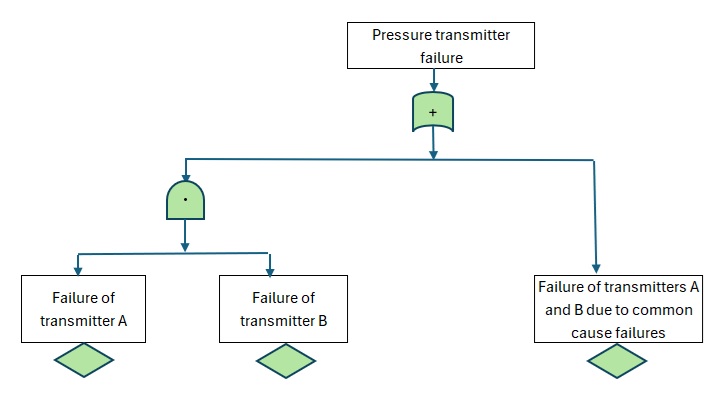
Other ways that CCF can happen include when the same individual maintains and calibrates both instruments; if the calibration set is misunderstood, the error could happen in both devices.
Different types of barriers can also experience the same incident, such as pressure safety valves (PSV) and pressure and vacuum relief valves (PVRV).
What can be done to lessen the likelihood that CCF may occur?
- In a risk analysis, discuss the possibilities of simultaneous disabling in two or more pieces of equipment due to obstruction, incorrect maintenance, wrong specifications, improper bypass, equipment stress due to temperature, corrosiveness, etc. Although we are aware that using this strategy on a daily basis is challenging, it is worthwhile for the analysis facilitator to highlight these themes;
- Consider the diversity of technology;
- Implement physical separation;
- Steer clear of shared sensors and actuators between the BPCS and SIS if feasible;
- Different teams should be assigned for the maintenance of redundant equipment, and so on.
Common causes of failure for instruments, refer to table D.1 of IEC 61508 part 6.